Last month, members of the Guelph Hiking Trail Club and the Guelph Off-Road Bicycling Association packed a City Council meeting over something most Guelph residents never heard about: a well-worn crossing on the Radial Line Trail, near the Guelph Innovation District, had quietly been closed off with new signage — courtesy of Guelph Junction Railway, the freight railway the City of Guelph has owned outright since 1910. The reason given was safety. But here's the problem with that: posting a closed sign on a crossing people already use every day doesn't make anyone safer. It just tries to absolve responsibility.
Planners have a name for the paths people wear into the ground when the official route doesn't match how they actually move: desire lines. This crossing is one of them. The runners, cyclists, and families who've crossed here for years aren't going to stop because a sign went up, they'll just cross with less guidance about how to do it safely, not more. Close the crossing and GJR's (the City's) risk arguably goes up, not down. The question was never “open or closed.” It's “safe or unsafe.”
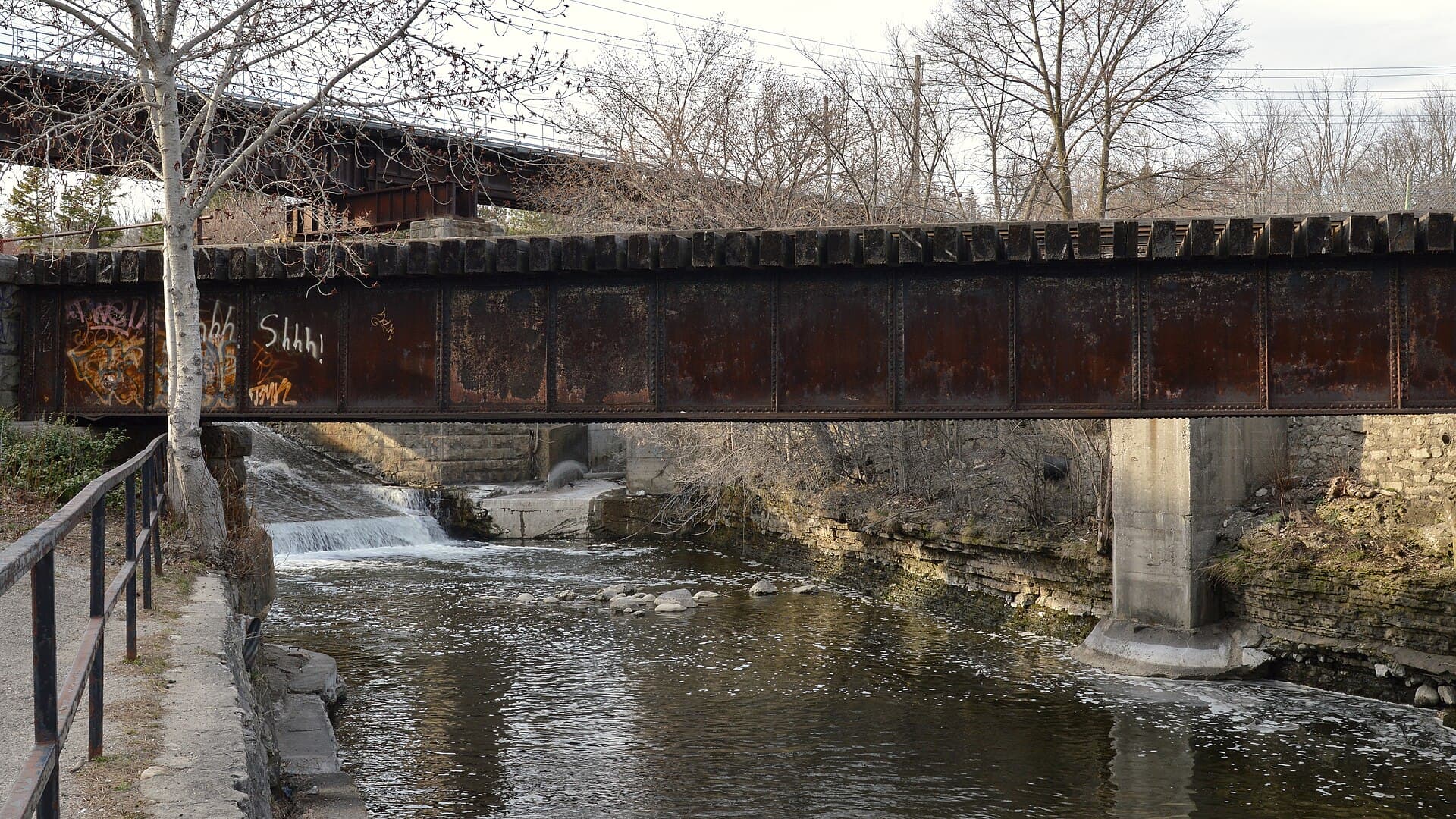
GJR's liability worry isn't crazy on its face. The trail and the tracks sit on land owned by two different parties, and the moment someone steps from one to the other at a spot nobody ever formally engineered for it, GJR is on the hook if something goes wrong. Fair enough. But the answer to that isn't a sign telling people to stop. It's a properly built, legally sanctioned crossing — the kind that actually manages the risk instead of pretending it away. That costs money. So who pays?
Here's what should bother every Guelph taxpayer: the money is already there. In 2025 — the same year this dispute became public — GJR posted $2.4 million in profit and ended the year with $4.0 million in cash and cash equivalents, double the $2.0 million it held a year earlier. The City's own staff report calls $3.2 million of that unrestricted and “available to fund current operations and capital investment in 2026.” And GJR spent zero dollars on crossing equipment or bridge work, after spending more than $700,000 on those exact categories the year before. By its own rules, it only ever has to hand the City up to 10 percent of its annual profit as a dividend — the other 90 percent stays with GJR. This is NOT a company that's short of money. It made a choice about where that money went, and trail safety lost.
Councillor Rodrigo Goller saw this clearly at that same meeting and tried to fix it: a motion to tie a share of GJR's dividend to safety infrastructure. Three parts of his motion passed. That part didn't — ruled out of order, because Council, sitting as GJR's shareholder, can't simply redirect money the City has already claimed as its own. Good instinct Mr. Goller, but the wrong tool.
Here's a fix that doesn't hit that wall. And this part is worth reading twice, because it's easy to hear it as something it isn't. The dividend GJR already pays the City every year? Leave it completely alone. Not a cent of it moves. It goes exactly where it's always gone, into the City's Infrastructure Renewal reserve fund. What I'm proposing sits on top of that: a second, separate payment, sized to match some portion of the dividend, earmarked for one purpose only — building and upgrading legally sanctioned, safe crossings along GJR's line.
GJR's dividend to the City has climbed from $80,000 in 2020 to $250,000 last year. If GJR hands over a $250,000 dividend, it should also set aside an amount for safe crossings. Nothing is redirected from the City's budget. Nothing is added to anyone's tax bill. A share of the railway's own profit gets reinvested into the one corridor it's responsible for.
GJR's dividend to the City keeps climbing
Annual dividend paid to the City of Guelph, 2020–2025
- 2020$80K
- 2021$0
- 2022$105K
- 2023$164K
- 2024$210K
- 2025$250K
| Year | Dividend |
|---|---|
| 2020 | $80,000 |
| 2021 | $0 |
| 2022 | $105,000 |
| 2023 | $164,000 |
| 2024 | $210,000 |
| 2025 | $250,000 |
And that money shouldn't just land in a bank account. Put GJR, the City's engineering and parks staff, and the trail groups themselves on a small standing committee that decides, in public, which crossing gets fixed each year. The trail community doesn't just want a cheque. They want a real say in the fix, and they've earned one.
There's already a template for this. A pedestrian crossing at Heffernan Street was built with a Trans Canada Trail grant covering about a fifth of the cost, the City and GJR splitting the rest. And GJR's own latest annual report says it's already quietly exploring a formal, safe replacement crossing at this exact location — it just hasn't set a deadline. This fund gives that project a budget and a date.
It also doesn't help that GJR's CEO is also the City's own General Manager of Parks — the department you'd expect to be the trail community's biggest advocate is currently also the one closing crossings. That's not a knock on the person in the job. It's exactly why this needs to be a rule, not an arrangement that depends on everyone's good faith lining up.
One more piece: this same fight has now played out, unresolved, at four straight GJR annual meetings. So the next time GJR closes an informal crossing, give it 90 days to publicly report the safety concern, a funded option for a safe alternative, and a timeline — in open Council, not buried in a glossy annual report. “We're still exploring this” stops being an acceptable answer, year after year.
This isn't a tax increase, and it isn't City Hall handing a grant to whichever group shows up loudest. It's a permanent rule: if Guelph's own railway keeps posting multimillion-dollar profits, a fair share of that gets reinvested in making its own corridor safe for the people who live and walk beside it. We've owned this company outright for over a century. That's not too much to ask of it.
If elected to Council this October, I'll bring exactly this forward: a motion directing City staff to build this rule into GJR's governing policy, with a real deadline attached. Guelph doesn't need another year of “still exploring.” It needs a decision.
— Jon Christensen is a candidate for Guelph City Council, Ward 5.